By Z. Aw | Published | Updated

The 5-min AI workflow audit: how to find your SG SME's first PSG-ready use case
This is the same conversation our sector advisor walks SME owners through every day. We boiled it down to a five-question worksheet that fits on the back of a kopi receipt.
The live version lives at the advisor. Five minutes in, a tailored plan out, grants matched.
Why "let's adopt AI" usually stalls
Most SME owners in Singapore have already had the AI conversation internally. Someone forwarded a McKinsey deck, the boss asked "so what should we do?", and the room went quiet.
The room goes quiet because the question is the wrong size. "Adopt AI" is a bucket that holds everything from a $20/month ChatGPT seat to a six-figure custom vision system. Useless prompt for a decision.
The big consultancies filled that gap with maturity models. McKinsey publishes a five-stage AI maturity assessment. IDC has its AI MaturityScape benchmark. There's also the familiar Build-Buy-Borrow decision frame floating around boardrooms - useful, no need to credit a particular firm for it.
These frameworks earn their keep at large enterprises with chief data officers and 18-month transformation budgets. They are useless for a 30-person engineering shop in Tuas choosing between a vision QC pilot and an LLM-drafted SOP system.
Maturity models ask "where are you on the curve?" The right SME question is sharper: which one painful workflow, this quarter, would survive a Productivity Solutions Grant application?
The room goes quiet because the question is the wrong size. "Adopt AI" is a category containing everything from a $20/month ChatGPT seat to a six-figure custom vision system.
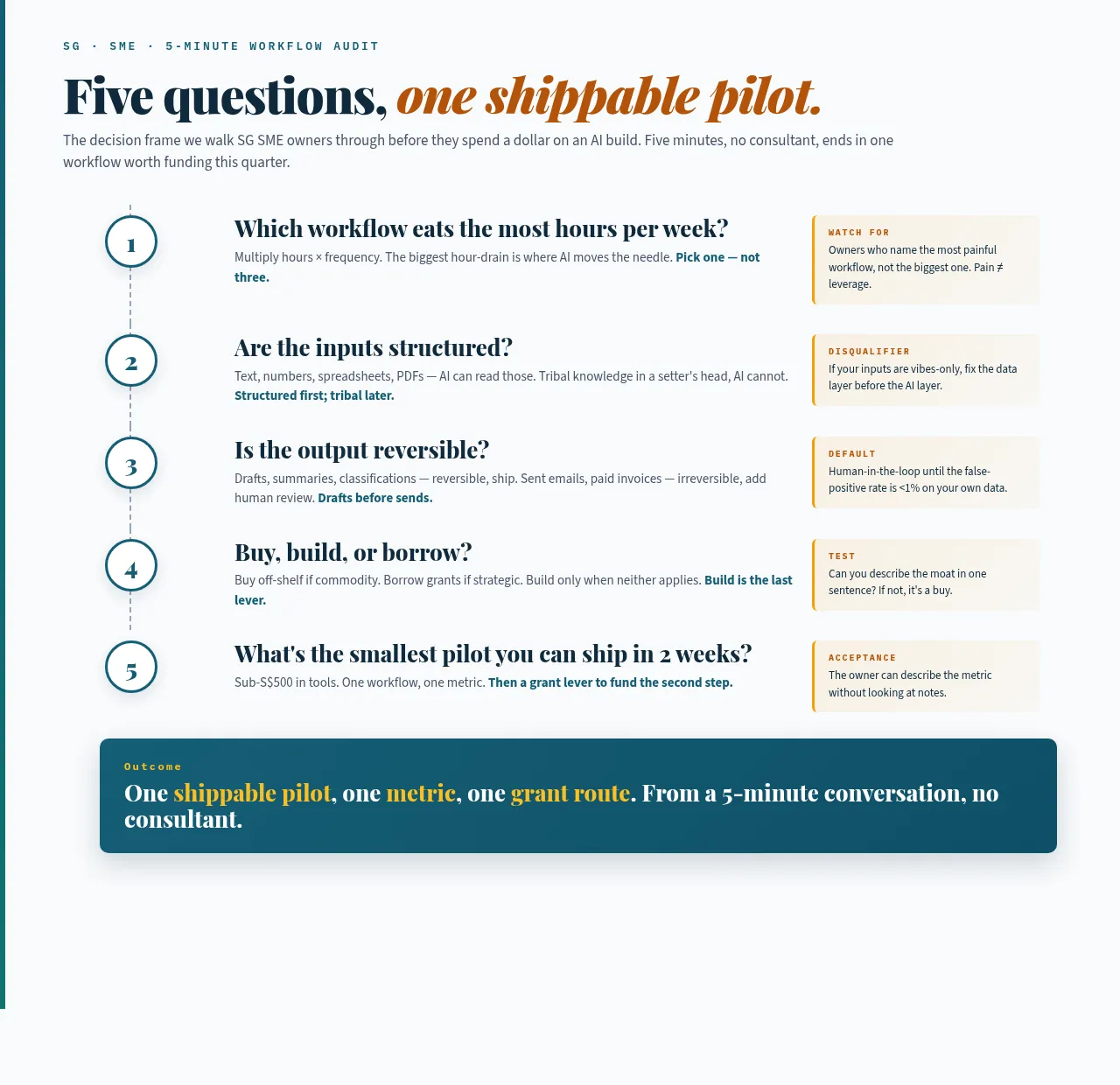
The 5-min audit: five questions, in order
Five sequential filters. By the end, founders walk away with one use case, sized to budget, with a grant lever already identified.
The triad our sector advisors run on: People, Process, Systems. Every workable AI use case touches all three. Skip any one and the pilot dies.
Question 1 - Which workflow eats the most supervisor time this week?
Not the sexiest workflow. The one bleeding hours from a senior person too expensive to be doing it.
Write it in one sentence. "Our QA lead spends three afternoons reconciling delivery orders against invoices" is a use case. "We want to be more data-driven" is not.
Question 2 - Is the pain in People, Process, or Systems?
People = tribal knowledge, a senior person retiring, or six-month new-hire training.
Process = manual, repetitive, chaotic steps. Paperwork, scheduling, copy-paste between systems.
Systems = data locked in un-queryable formats. PDFs, scanned forms, WhatsApp threads, scattered spreadsheets.
The first workable use case is almost always a Process or Systems pain with a People dimension attached. Pure People pains rarely have a clean AI fix. Pure Systems pains are usually IT modernisation projects wearing an AI costume.
Question 3 - How is the work captured today?
AI cannot learn from work that leaves no trace.
"It's in our ERP", "spreadsheets", or "the supervisor types it up Friday" all count as structured input. Good. "It lives in our team lead's head and he WhatsApps customers from his personal phone" does not. The first project there is digitisation, not AI.
Half the failed pilots we see across SG SMEs are AI bolted onto workflows that were never digital in the first place.
Question 4 - What does "good" look like, in numbers?
If the use case worked perfectly in six months, what would the metric say?
"Two hours a week back to the QA lead." "Defect rate down from 1.2% to under 0.4%." "Supervisor stops working Saturdays to close batch records."
If you cannot define success in numbers, you cannot write a PSG application for it. Grant officers ask exactly this question.
Question 5 - What is the fastest way to test it for under $500?
Every workable AI use case has a sub-$500 dirty version. ChatGPT Plus and Claude Pro run $20/month. Roboflow's free tier trains vision models. NotebookLM swallows troubleshooting notes for nothing.
If you can't picture a sub-$500 pilot, the use case is too big. Cut it down, run the dirty version for two weeks, and measure against Question 4.
Walk-through: a 30-person manufacturing shop in Tuas
Here's how the audit plays out for a generic precision-engineering SME. The shape of this case is something our advisor sees several times a week.
Question 1 - biggest time sink. The production supervisor spends five hours every Friday closing batch records, ISO documentation, and audit-trail entries by hand.
Question 2 - People, Process, or Systems? Mostly Process, with a People angle. The work is repetitive but the supervisor's judgment is what flags exceptions.
Question 3 - how is it captured? Shop-floor data sits in the MES and scanned operator log sheets. The supervisor pulls from both into a Word template. Structured input a model can read.
Question 4 - what does good look like? Five hours back weekly. Zero missing-field errors on audit trails. Supervisor reviews instead of drafts.
Question 5 - sub-$500 pilot. Microsoft 365 Copilot at $30/user/month fed MES exports and log scans with a custom prompt. Or a Claude Pro seat with SOP templates in a Project. Either runs well under $500 for the pilot phase.
This survives a PSG application because Copilot is pre-approved. It survives an EDG application once scaled into a custom build. Critically, the supervisor stays in the loop, which is how it survives an ISO audit.
How the audit output feeds a PSG/EDG-fundable plan
The audit is step one. The grant pays for step two.
The Productivity Solutions Grant covers up to 50% of pre-approved digital and AI tools. The Enterprise Development Grant covers up to 50% of bespoke AI builds, consultancy and internal manpower included.
The Enterprise Innovation Scheme is the quiet giant. IRAS allows up to 400% tax deduction on qualifying R&D and innovation spend on the first $400K, AI for quality control, predictive maintenance, and process optimisation included. Manufacturing SMEs are leaving real money on the table here.
Grant matching gets lined up at the end of every advisor session: PSG, EDG, EIS, SkillsFuture Enterprise Credit, and the A*STAR/SIMTech research collaboration route where it fits. The audit itself is unfunded. What the audit produces gets funded.
The sector advisor pages cite Enterprise Singapore and IRAS source URLs directly, so founders can verify coverage before committing.
Common audit traps: three ways SMEs over-spend
Trap one: over-scoping. One workflow, one supervisor's pain, one metric. Companies that try to boil the ocean burn their PSG quota on scoping and ship nothing.
Trap two: picking sexy over painful. Generative AI marketing copy is exciting and probably not the bottleneck. Knowledge capture from senior techs, SOP automation, and batch-record drafting are unsexy precisely because they are valuable.
Trap three: ignoring data gravity. If the work isn't captured anywhere a model can read it, the first project is boring digital plumbing. Spreadsheets, shared drives, structured forms, consistent file naming. We sometimes prescribe a six-week digitisation sprint before any AI pilot. Owners are sceptical until the pilot succeeds because of it.
How we run this, and why Lyra sits on top
The sector advisor runs this conversation every working hour. The plan it produces gets piped into Lyra, our agent-driven CRM, where it becomes a tracked project with milestones, owner gates, and a human-in-the-loop audit trail.
Under the hood the advisor leans on sgdata-mcp to ground recommendations in current ACRA, IRAS, and Enterprise Singapore data. Grant references and tool pricing aren't hallucinated.
We share this framework openly because the bottleneck for AI adoption among SG SMEs isn't technology. It's the missing first conversation.
Run the audit, then talk to us
Five questions. People, Process, Systems. One workflow, one metric, one sub-$500 pilot, then a grant lever to fund the second step.
If founders want an advisor who has seen a thousand shop floors to walk them through it in five minutes and hand back a plan with grants matched, that's exactly what altronis.sg/advisor does. No signup, free, anonymous.
Frequently asked
Can I audit my AI workflow without hiring a consultant?
Yes. The 5-minute audit is five questions covering people, process, and systems. Walk through them honestly, pick the highest-leverage workflow, and ship one sub-S$500 pilot. The diagnostic is the easy part; the discipline to ship one thing instead of three is the hard part.
What grants in Singapore can fund a small AI pilot?
Productivity Solutions Grant (PSG) covers pre-approved AI tools at up to 50% co-funding. Enterprise Development Grant (EDG) covers custom AI projects with up to 70% co-funding for SMEs from April 2026 (was 50% before). SkillsFuture Enterprise Credit (SFEC) provides an S$10,000 credit covering up to 90% of out-of-pocket costs on approved transformation programmes. Match the grant to the workflow shape, not the other way around.
How small should the first AI pilot be?
Sub-S$500 cash, two weeks of effort, one workflow, one metric. If it does not save 20% of cost or time on a real measurement, kill it and pick another workflow. The pilot is a probe, not a transformation.
Why do most SME AI projects fail in Singapore?
Three reasons we see repeatedly: starting with a technology rather than a process, picking workflows that do not have a measurable cost baseline, and treating AI as a project with an end date instead of a capability that needs ownership.
Related reads
Last updated 31 May 2026.