By Z. Aw | Published | Updated

EDGE 2026: the new SG SME grant landscape and how to fund AI under it
Singapore is collapsing EDG, PSG and MRA into one scheme. It is called EDGE and it lands in 2H 2026. The rules around AI funding are at once tighter and more generous, and most SMEs we speak to have not yet figured out what that means for a project they are scoping today.
What changed
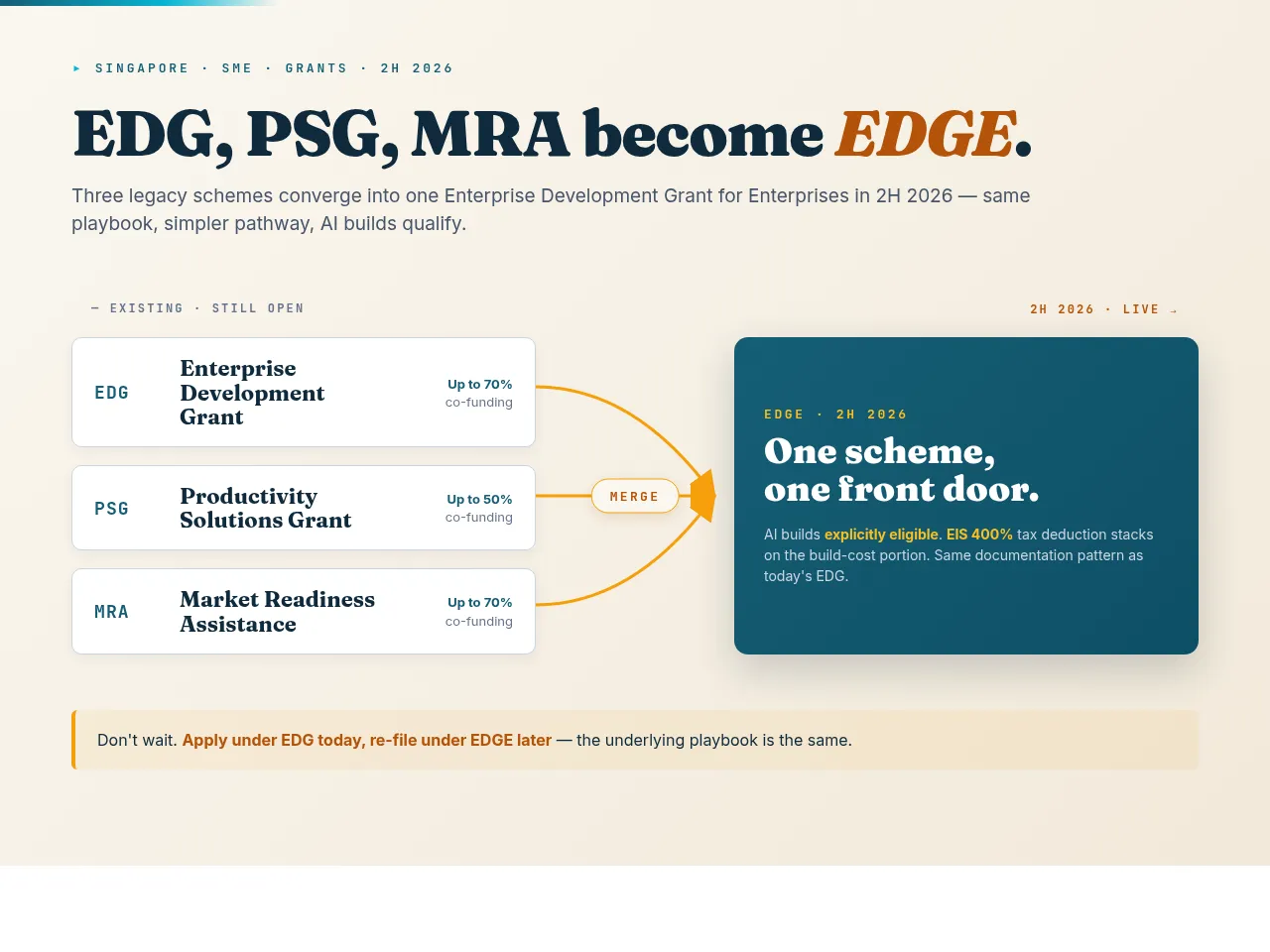
Budget 2026 folds the Enterprise Development Grant (EDG), Productivity Solutions Grant (PSG) and Market Readiness Assistance (MRA) into EDGE, short for Enterprise Development and Growth for Enterprises (Raffles Corporate Services).
One application on the Business Grants Portal will now do the work of three. No more figuring out whether a project is "capability building" (EDG), an off-the-shelf tool buy (PSG), or an overseas push (MRA), then writing a different proposal for each. EnterpriseSG describes EDGE as a scheme that "streamlines the Market Readiness Assistance (MRA), Productivity Solutions Grant (PSG), and Enterprise Development Grant (EDG) into a single scheme" (EnterpriseSG Budget 2026).
Headline numbers worth committing to memory: S$100,000 per company per year, up to 50% co-funding on capability and digitalisation work, and internationalisation co-funding bumped to 70% for SMEs and 50% for non-SMEs (Raffles Corporate Services, GovMedia).
EDGE also widens the door. The scheme "will be available to all Singapore businesses, including non-SMEs" (EnterpriseSG), so mid-sized firms above the SME threshold can apply too, just at the lower co-funding tier.
"We will buy a chatbot from vendor X" almost never funds. "We will deploy an AI agent on our internal sales workflow, train two staff to maintain prompts and data pipelines, and reduce response time on supplier quotes from 48 hours to under 4" usually does.
Timeline and transition rules
EDGE launches in 2H 2026. Until it does, EDG, PSG and MRA remain the only ways to get co-funding.
The interim guidance from EnterpriseSG is plain: businesses "can continue applying for the EDG, MRA and PSG via the Business Grants Portal (BGP)" while we wait (EnterpriseSG Budget 2026). Anything already approved under the old schemes will be honoured (Raffles Corporate Services).
Two enhancements kick in before EDGE itself. From 1 April 2026, MRA support climbs to 70% for SMEs and the S$100,000 cap (per new market) is extended (EnterpriseSG Budget 2026, GovMedia).
The second is a quiet but useful change. From 2H 2026 the old "new to target overseas market" rule goes away, which means grant money can be used to deepen a presence in a market the firm is already in, not just to break into a fresh one (GovMedia).
So the practical fork in mid-2026 looks like this. Apply now under legacy schemes and dodge the EDGE-launch teething issues, or hold off if our project genuinely needs EDGE's wider scope.
How AI projects fit under EDGE
EDG already covered AI work across "process redesign using AI to optimise workflows, automation implementing AI-powered systems, product development integrating AI features, and data analytics building AI-driven business intelligence capabilities" (Innovatrix Infotech).
EDGE inherits all of that and turns the volume up on AI and digital. Internal copilots. Document processing. Customer-service automation. Sector-specific advisors. Sales and CRM intelligence. They all sit comfortably inside its capability and digitalisation pillar.
The qualification bar has not moved. An AI project still needs to clear four tests: real technology (ML, NLP or computer vision, not a rebadged Excel macro), some level of innovation, demonstrable business impact, and capability development inside the firm (Innovatrix Infotech).
That last one is where most rejected AI applications fall over. EnterpriseSG is not paying for a vendor handover. They are paying for the SME to actually operate the AI after the consultants leave the building.
The applications that get through tend to share three things. A named workflow and a named team that owns it. Data sources spelled out, not handwaved. And a clear path for the SME to keep running the system once the engagement ends, with training, documentation and exit criteria written in.
"We will buy a chatbot from vendor X" almost never funds. "We will deploy an AI agent on our internal sales workflow, train two staff to maintain prompts and data pipelines, and reduce response time on supplier quotes from 48 hours to under 4" usually does.
This is roughly how we build at Altronis. Our sector advisors live at advisor.sport and advisor.manufacturing. Our CRM and ERP layer is Lyra. Our news pipeline runs on Qwen3.6 35B-A3B locally on a Strix Halo workstation, pulling 91 items a week across 16 sources, and our open-source MCP for SG government data is sgdata-mcp. The shape of an EDGE-fundable AI build looks much the same: defined workflow, measurable outcome, internal capability built alongside the vendor work.
Stacking with EIS: the 400% tax deduction is a separate lever
EDGE is a co-funding grant. EIS is a tax deduction. Different agencies run them, and the two stack.
EIS lets businesses claim enhanced tax deductions of up to 400% on the first S$400,000 of qualifying R&D expenditure in Singapore per basis period (IRAS EIS page).
Budget 2026 extended EIS to cover AI specifically. Businesses can claim 400% deductions on up to S$50,000 of qualifying AI expenditure per Year of Assessment, applicable to YA 2027 and YA 2028 (Paul Wan & Co). IRAS is expected to issue further guidance on what counts as qualifying AI expenditure by mid-2026 (Alvarez & Marsal).
A worked example. An S$100,000 AI project gets S$50,000 of EDGE co-funding at the 50% rate. The SME's own S$50,000, if it clears the EIS-qualifying tests, yields a 400% deduction - roughly S$34,000 of tax saved at the 17% corporate rate (IRAS). Net cash out the door, after both: about S$16,000.
Two caveats sit behind that example. The EIS cash-payout option does not apply to AI expenditure (Alvarez & Marsal), so the AI portion can only be used as a deduction. And the deduction only applies to costs the firm actually paid; the EDGE-funded slice is not deductible on top.
For a profitable SME, EIS is a meaningful second layer of relief. For a loss-making one, EIS on AI does not convert to cash - it sits in the books as a deferred benefit until the company is in the black.
Practical action steps for SG SMEs in 2026
-
Do not wait for EDGE if a project is ready now. EDG, PSG and MRA remain open and approved applications will be honoured (Raffles Corporate Services). Apply before signing vendors or paying anything (EnterpriseSG EDG page).
-
Scope around an internal workflow, not a tool purchase. Grant officers fund capability uplift. Frame the proposal around the team that will run the AI system, the workflow it improves, and the outcomes that will be measured.
-
Separate EDGE-eligible costs from EIS-eligible costs from day one. The firm's own share of an EDGE-funded project can be deducted under EIS, but only if the books are clean enough to show which dollar paid for what.
-
Watch for the IRAS guidance update on qualifying AI expenditure, expected mid-2026 (Alvarez & Marsal). Model the finance plan as if EIS were not available. Treat any EIS deduction as upside.
-
For overseas expansion, time the application. Apply under MRA before April 2026 (existing rules), between April and the EDGE launch (70% rate), or after EDGE goes live (full flexibility, including existing markets).
The grant landscape is not the bottleneck. The bottleneck is having a clearly scoped AI project with named owners, a measurable outcome, and a plan to keep operating the system once the vendor walks out.
Where to start
Our sector advisors at altronis.sg/advisor generate a free 5-minute growth plan that covers AI use cases, expected impact and a rough funding path. For scoped AI builds with grant-aware project structuring, contact [email protected].
Frequently asked
What does the 2026 SG SME AI grant landscape actually cover?
Three primary tracks: PSG (up to 50% on pre-approved AI tools; cap varies by sector and tool - for example built-environment PSG caps at S$50,000 over 5 years from April 2026), EDG (up to 70% co-funding for SMEs from April 2026, raised from 50%, no fixed ceiling on custom AI projects), and SFEC (S$10,000 credit covering up to 90% of out-of-pocket costs on approved transformation programmes). Match the tool/scope shape to the grant, not the other way.
Does my SME need to be SG-incorporated to claim?
PSG and EDG require SG-incorporated entities with at least 30% local shareholding and turnover ceilings. SFEC follows the SkillsFuture eligibility rules. Most foreign-owned SMEs in SG can still claim through a local subsidiary.
How long do AI grant approvals take in 2026?
PSG is the fastest - Enterprise Singapore states each complete application typically takes around 6 weeks because the tools are pre-approved. EDG generally runs longer (8–16 weeks based on what we see) because each application is custom-evaluated. Plan procurement timelines accordingly; do not start the pilot waiting for the grant to clear.
Related reads
Last updated 31 May 2026.