By Z. Aw | Published | Updated
AI ROI math for SG SMEs: when does the running cost outweigh the build cost?
A finance lead at a 120-person Singapore SME asked us why his AI pilot's monthly invoice kept climbing while the use case hadn't changed. The build was the cheap part.
The day-2 cost trap nobody quotes for in the proposal
Vendors quote build cost. Discovery, integration, prompt engineering, deployment. The line item that wrecks AI budgets sits underneath all of that.
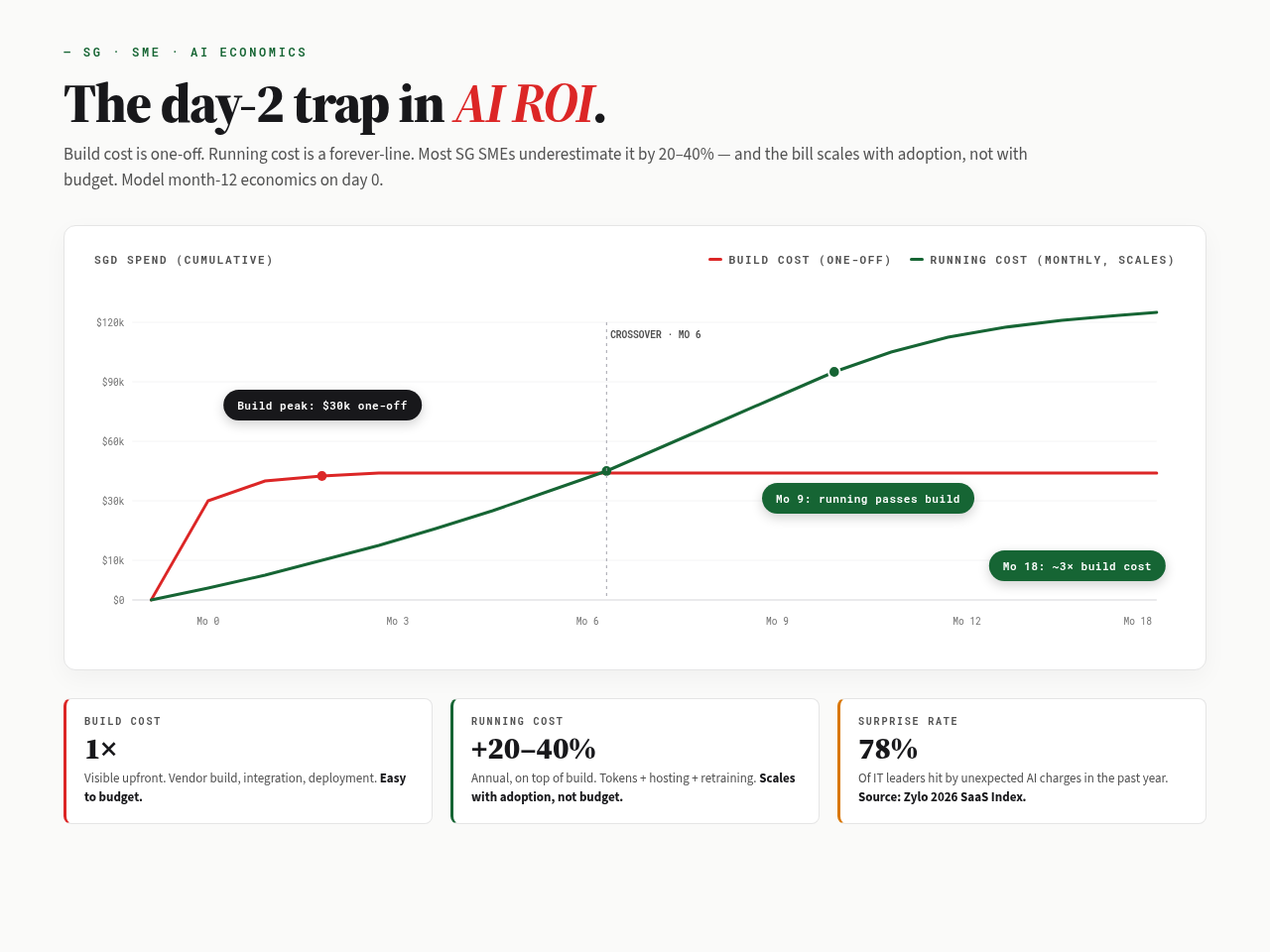
Operational cost runs every month after go-live: token spend, retraining, observability, integration drift. Metered, scaling with usage, no cap.
Reinventing.ai's SMB pricing brief reports integration, data prep, and optimisation add 20-40 percent to initial budgets, with monthly hosting and maintenance for a custom SMB agent running S$700 to S$14,000 [1]. Zylo's 2026 SaaS Management Index, drawn from $75B in SaaS spend under management, found 78 percent of IT leaders reported unexpected charges tied to AI features or consumption-based pricing in the past year [2].
We call the discipline "AI-nomics". Tokens, retraining, and orchestration as a metered utility, not one-time capex. SMEs that skip it quietly kill their pilots around month nine.
Reinventing.ai's SMB pricing brief reports integration, data prep, and optimisation add 20-40 percent to initial budgets, with monthly hosting and maintenance for a custom SMB agent running S$700 to S$14,000 [1].
Why traditional software ROI math fails on AI
Per-seat SaaS has a predictable cost curve. Ten more users means ten more seats.
AI isn't per-seat. It's per-call, per-token, per-document, per-audio-second. Often all at once.
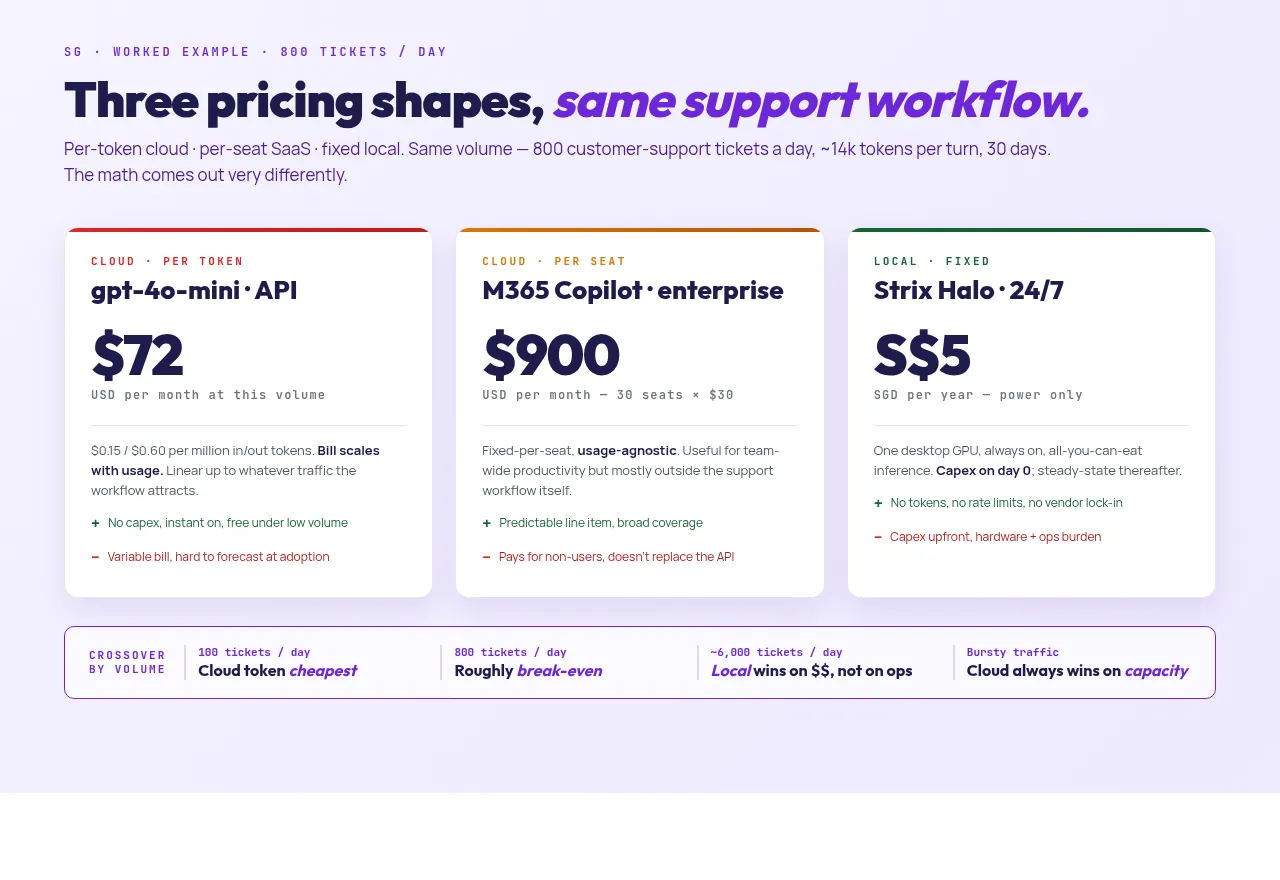
A customer-service agent handling five tickets a day looks free in a demo. The same agent at 800 tickets daily, 12k input tokens and 2k-token replies each, lands somewhere materially different. At 2026 GPT-4o-mini rates of US$0.15 per million input tokens and US$0.60 per million output tokens, that single workflow runs about US$72 a month before guardrails, retries, or evaluator calls [3].
AI cost is a usage variable, not a seat variable. If a CFO sees an AI proposal where the only running-cost line item is "monthly subscription," the proposal is missing a column.
The 3-month vs 12-month vs 36-month curves
Build cost dominates the first quarter. By month twelve, running cost has typically caught up.
By month thirty-six, running cost decides whether the project pays back at all.
Here's a worked sample for a mid-volume SG SME workload. An internal AI assistant doing 10,000 document summarisations a month, roughly 8k input + 1k output tokens each, on a cloud API.
- Month 0-3 (build phase). Discovery, integration, prompt iteration, evaluation harness: S$25,000 to S$60,000 one-off. Token spend during pilot: roughly S$200 a month.
- Month 4-12 (steady state). Token spend on GPT-4o-mini-class models: roughly S$170 a month at 10k calls. Add observability, eval re-runs, prompt updates, on-call: S$2,500 a month loaded. Annualised running cost: about S$32,000.
- Month 13-36 (scaled). Volume typically 3-5x as adoption spreads. Token spend climbs to S$700-S$1,200 a month. By end of year three, cumulative running cost commonly equals 1.5-2x the original build cost [1].
JPMorgan Chase Institute's transaction-data work shows the 2019 SMB AI cohort grew their monthly bill 80 percent over six years, and the 2021 cohort grew 50 percent in four. Established adopters deepen spend; they don't flatten it [4].
The 36-month line is where the day-2 trap closes.
The local-vs-cloud breakpoint - our actual news pipeline
Altronis runs a news pipeline that scores, summarises, and tags relevance for SG-energy and SME-technology beats. Volume sits at roughly 91 items a week, each averaging 6k input tokens plus 500 tokens of structured output.
We sized two options before building.
- Cloud API path. GPT-4o-mini at US$0.15 input / US$0.60 output per million tokens. 91 items × 52 weeks × 6,500 tokens = roughly 30.8M tokens a year. Annual API cost: approximately US$5.70 in tokens.
- Local path. Qwen3.6 35B-A3B running on a Strix Halo desktop (128GB unified memory, llama.cpp with Vulkan). Marginal cost per inference: electricity. Annual run cost: roughly S$220 in power.
Token pricing alone made cloud look fine. The math broke once we layered in production realities.
Re-runs after prompt edits multiply tokens by 3-5x during the first six months. Evaluator passes double the token bill. Retries on schema-failure add roughly 30 percent. Multi-step pipelines multiply call count by the number of stages. Realistic loaded cloud cost sat closer to US$60-90 per year of pure tokens, plus the lock-in cost of every prompt change going through a metered pipe.
Local has a different shape. We pay hardware once. Iteration is free. Evaluator passes are free. Multi-stage pipelines cost the same as single-stage ones, because nothing is metered.
For a workload with stable schema, stable volume, and a heavy iteration tail, local won cleanly. Bursty, low-volume, latency-critical workloads still belong on a cloud API. The point: the breakpoint exists, and a CFO needs to know where it sits for each workflow.
If a workload is repeatable, schema-bound, and we'll be re-running it as we tune prompts, price it both ways before signing the API contract.
How PSG, EDG, and EIS reframe the math
Singapore's funding stack changes the cost shape in ways most vendors don't model. The 2026 budget made this materially better for SMEs.
Budget 2026 expanded the Enterprise Innovation Scheme. Qualifying AI expenditure now triggers a 400 percent tax deduction, capped at S$50,000 per Year of Assessment for YA2027 and YA2028 [5]. Spend S$10,000 on qualifying AI tools or training, claim a S$40,000 deduction on top of the base, and save roughly S$6,800 at the 17 percent corporate rate.
PSG and EDG remain the front-loaded grants. Typically 50-70 percent off pre-approved AI tools and bespoke transformation projects respectively. Stack EIS on the unfunded remainder and the loaded build cost drops to 15-30 percent of sticker.
Two caveats. EIS is a deduction against taxable profit, not a cash payout. The benefit only realises if the SME is profitable that year. And the 400 percent rate applies to qualifying AI activity; IRAS guidance on definitions is still firming up, expected mid-2026.
We treat the funding stack as a build-side discount, not a running-cost reducer. It makes the build phase cheaper. It doesn't move the day-2 curve. CFOs who plan around grant-funded build cost without modelling sustainment walk into the same trap, just twelve months later.
Four questions to ask before approving any AI tool subscription
- Per-seat or per-call? If the vendor can't give a usage-based projection at three volume tiers (low / expected / 3x expected), the proposal is incomplete. Ask for the curve.
- What does the iteration cost look like? In the first six months, prompt changes, eval runs, and schema updates will easily 3-5x the steady-state token bill. If the contract is metered, every iteration shows up on the invoice. Budget that line explicitly.
- What is the breakeven volume for self-hosting? For any workload with stable schema and meaningful repeatability (document processing, classification, summarisation, internal search) get a local or self-hosted comparison quote. Cloud often wins for low volume. Local often wins above a workload-specific threshold.
- How is sustainment funded after year one? Build is a one-off. Running is forever. If the team running the AI in year two is the same team that ran it in year one without budget growth, something breaks. Usually model accuracy, sometimes the budget, often both.
CFOs who do this well treat AI like a metered utility from day one. Separate cost centre, monthly variance review, capacity-and-cost dashboards. CFOs who treat it like SaaS get a surprise in month nine.
Closing
We built our news pipeline on a desktop because the math told us to. Same math we pitch to every SG SME we advise. The build cost is real, the running cost is realer, and the gap between the two is where most pilots quietly die.
For a quick read on what a specific workload should cost over 36 months, including local-vs-cloud breakpoint and PSG/EIS stacking, altronis.sg/advisor runs a five-minute plan with concrete numbers.
Sources
[1] Reinventing.ai - AI Agent Pricing for Small Businesses: Comparing Real Costs in 2026, 8 April 2026. https://insights.reinventing.ai/articles/ai-agents-cost-performance-smb-2026-04-08
[2] Zylo - 2026 SaaS Management Index: How AI Is Reshaping SaaS Costs. https://zylo.com/reports/2026-saas-management-index/
[3] OpenAI API Pricing, GPT-4o-mini rates as of April 2026. https://openai.com/api/pricing/
[4] JPMorgan Chase Institute - Understanding the use of AI among small businesses. https://www.jpmorganchase.com/institute/all-topics/business-growth-and-entrepreneurship/understanding-ai-use-by-small-businesses
[5] IRAS - Enterprise Innovation Scheme (EIS). https://www.iras.gov.sg/schemes/disbursement-schemes/enterprise-innovation-scheme-(eis) and Singapore Budget 2026 announcement, 18 February 2026.
Frequently asked
What does day-two AI ROI look like for an SG SME?
Day-one ROI is the demo savings - usually overstated. Day-two is what survives six months: drift in prompt outputs, model price changes, edge cases the pilot did not see, the human time still required to review. Real day-two ROI for a healthy AI deployment runs 30–50% of the day-one number.
How do I measure AI ROI honestly without gaming the metric?
Pick one numerator (cost saved or revenue earned) and one denominator (real elapsed time + cost of model + cost of human review). Track it monthly, not weekly, so day-two effects show up. Compare against the baseline you measured in week zero, not against the team's enthusiasm.
Why do AI projects succeed in pilot and fail in production?
Three patterns: scope inflation between pilot and prod (the pilot covered 1 case, prod gets 50), drift over time (model + prompt + data move out of joint), and the hidden human cost of escalation handling. The fix is to design for production constraints from day one, not to make the pilot more impressive.
Related reads
Last updated 31 May 2026.