By Z. Aw | Published | Updated

How to hire your first AI engineer for an SG SME - a practical rubric for non-tech-giant budgets
Most "AI engineer" JDs we see in Singapore were written for FAANG, copy-pasted by recruiters, and priced for skills an SME cannot use. This is the rubric we wish someone had handed us when we were staffing the team behind Lyra, sgdata-mcp, and the sector advisors at altronis.sg.
Section 1 - the "first AI engineer" trap
The most common SME mistake. Asking for a research scientist, an MLOps engineer, a data engineer, and a full-stack developer in one body. The role goes unfilled for six months, then gets quietly shelved.
A first AI hire does not need to invent new models. They need to wire existing ones into the business in a way that survives Monday morning.
The skill that matters at SME scale is integration discipline. Taking an off-the-shelf LLM or vision model and making it produce a reliable output that flows into a real workflow. Boring, but rare.
If we cannot articulate the first ticket our AI engineer will close in week two, we are not ready to hire one. Bring in a contractor for a month, watch what tickets actually emerge, and write the JD from those tickets.
FAANG AI engineers spend their time on training infrastructure, distributed systems, and squeezing 0.5% out of a benchmark. Almost none of that helps a Singapore SME ship its first internal copilot.
Section 2 - the skills that actually matter at SME scale
FAANG AI engineers spend their time on training infrastructure, distributed systems, and squeezing 0.5% out of a benchmark. Almost none of that helps a Singapore SME ship its first internal copilot.
What actually helps, in rough priority order:
Plumbing skills. Calling APIs, writing small Python services, using Docker, deploying to a cloud or a single server. If a candidate cannot stand up a FastAPI service that calls Anthropic or OpenAI and returns JSON, nothing else matters yet.
Prompt engineering as a real discipline. Writing a system prompt, running it across 50 sample inputs, measuring where it fails, iterating. Prompt eval is the new unit testing.
Retrieval and indexing fundamentals. Most SME AI value comes from feeding the model your own data: invoices, contracts, customer tickets, knowledge bases. Knowing how to chunk, embed, store, and retrieve beats knowing how a transformer attends to tokens.
Observability. Logging every model call with input, output, cost, latency, and a stable trace ID. Without it, no debugging, no improvement, no way to prove ROI.
A pragmatic security posture. Knowing that customer data should not go to a model whose terms allow training. Knowing what PDPA implies for prompt logs. Knowing when to push back on a stakeholder.
Notice what is missing. Deep learning theory, distributed training, custom CUDA kernels, vector database benchmarking at scale. Those belong on a research-engineer JD, not a first hire.
Ask each candidate to walk through the most recent thing they shipped to production. If they cannot point at a live URL, a deployed image, or a merged pull request, they have not done the job we need.
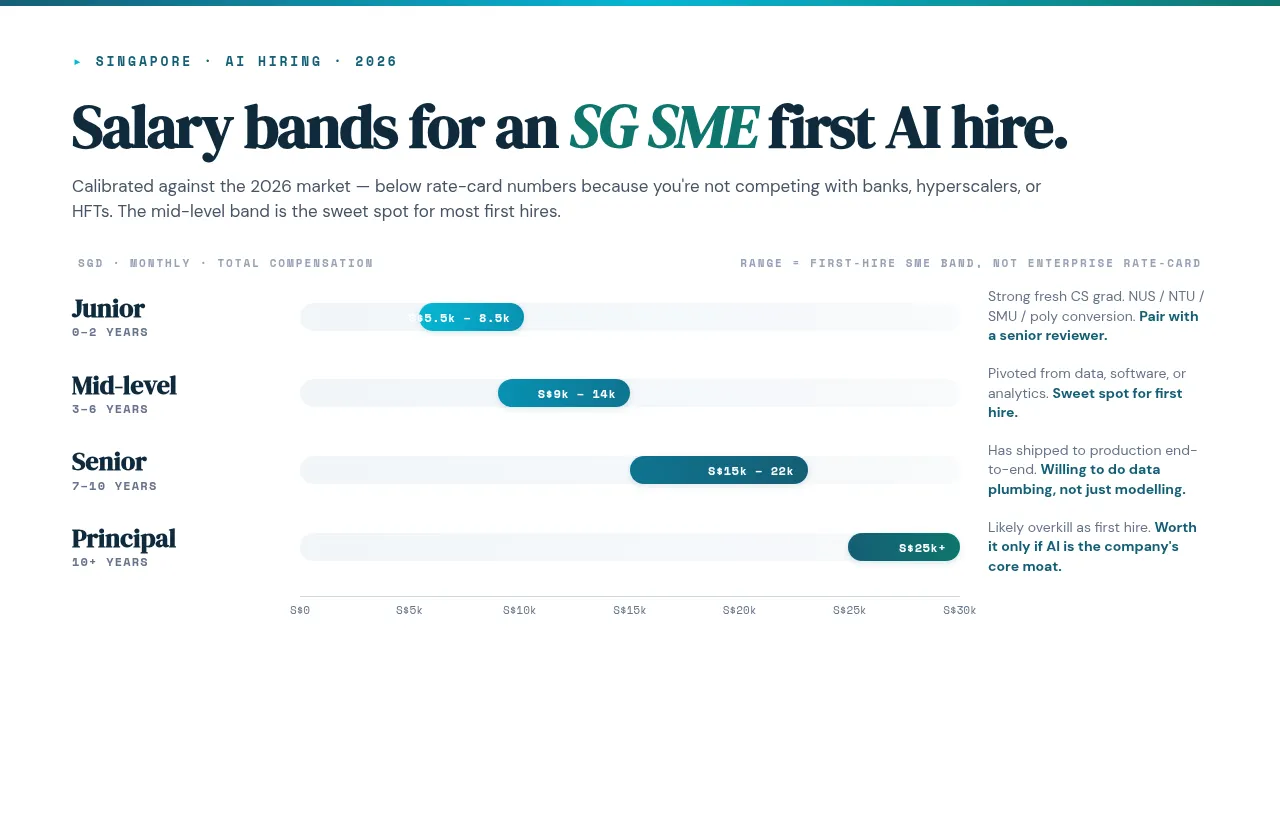
Section 3 - realistic 2026 SG salary bands
No single public data source is reliable. Here is our triangulation.
Junior (0 to 2 years). Second Talent's April 2026 rate card pegs juniors at S$7,500 to S$10,000 monthly (Second Talent, 2026). Morgan McKinley's 2026 AI/ML guide gives S$100,000 to S$170,000 annually for the broader category (Morgan McKinley, 2026). For a 50 to 200-person SME, realistic budget is S$5,500 to S$8,500 monthly for a strong fresh graduate from NUS, NTU, SMU, or a polytechnic conversion programme. Below rate-card because we are not competing with bank or hyperscaler offers.
Mid (2 to 5 years). S$10,000 to S$15,000 monthly per Second Talent (Second Talent, 2026). This is the sweet spot for a first SME hire. Enough scar tissue to ship something that works, not so senior they will be bored running an invoice-OCR pipeline. Realistic SME budget: S$8,000 to S$12,000.
Senior (5+ years). S$15,000 to S$22,000 monthly (Second Talent, 2026). We do not recommend senior as a first hire unless the engineer is expected to manage a team within a year. At that price, we are paying for leverage, not code.
LLM specialists with real fine-tuning experience tend to sit at the top of each band, occasionally above (Second Talent, 2026). For an SME, the premium is rarely worth paying. Retrieval, prompting, and evals will get founders 90% of the value at zero premium.
Glassdoor and PayScale produce much lower numbers, S$67k to S$100k annually (PayScale). Those datasets pool many job titles that don't match what an SME actually wants. Anchor on Second Talent and Morgan McKinley instead.
Section 4 - where to actually find candidates
LinkedIn is the obvious answer and the worst one. Every recruiter fishes the same pond, salaries get bid up by global tech HQs, and top-of-funnel candidates disappear within a week.
What has worked for us:
University career portals. NUS, NTU, and SMU run formal industry partnership programmes. NTU's College of Computing and Data Science (CCDS, formerly SCSE) publishes its employer pipeline openly (NTU CCDS, 2026), and the joint Graduate Employment Survey gives calibrated starting salaries (Universities.sg). Post directly, sponsor a final-year project, or offer a paid internship that converts.
IMDA TechSkills Accelerator (TeSA). The Company-Led Training programme co-funds salary and training costs for up to 12 months while a hire upskills (IMDA, 2026). The most underused funding lever in Singapore for 50 to 200-person SMEs.
NUS-ISS stackable certificates. The Institute of Systems Science runs stackable graduate certificates in intelligent systems that ladder into the MTech in Artificial Intelligence Systems (NUS-ISS, 2026). These candidates are usually pivoting in from software, data engineering, or analytics. Often better SME fits than fresh CS graduates because they already understand business context.
GitHub-first sourcing. Search for Singapore-based contributors to open-source AI repos. Look at commit-history quality, not star counts. We have hired well from contributors to LangChain, LiteLLM, llama.cpp, and various MCP server repos.
Contractor-to-hire. Bring someone in on a six to ten week scoped project. If they ship, convert them. If not, lesson learned without committing a year of salary. Second Talent's freelance rates (Second Talent, 2026) give a calibrated reference for the day-rate conversation.
Section 5 - red flags to filter on
Two failure modes dominate.
The ChatGPT power user who has never deployed. Ten LinkedIn posts on GPT-4 prompt techniques, fluent talk about agents and chains and tools, but has never written a service that handles a failed API call gracefully. Ask what their last production outage looked like. If they cannot answer, they have not been close enough to production.
The credential-padder. Stacks of Coursera certs, multiple bootcamps, but the GitHub is empty and the work history shows no AI engineering tenure. Certificates indicate intent, not skill. Ask for a deployed URL or a meaningful pull request.
Other patterns we screen for:
- "Built it on my Macbook." Never deployed to a remote environment, never dealt with secrets management, never debugged a 3am pager.
- Cannot articulate the cost of a single model call. Has never thought about token economics.
- Treats prompts as black magic. No testing or evaluation discipline.
- Wants to fine-tune everything. Usually means they have read papers but not shipped products.
- Cannot read someone else's code without rewriting it. A productivity sink at SME scale.
None of these are disqualifying alone. Two or more, pause.
Section 6 - a four-question interview rubric
We use a short interview that filters for SME fit specifically. Runs in about an hour.
Question 1 - the architecture sketch. "Imagine our customer-service team gets 200 emails a day. We want an AI assistant that drafts replies a human can edit and send. Sketch the system on the whiteboard."
Watch for: do they reach for retrieval over fine-tuning, do they think about logging and audit trails, do they ask about the human-in-the-loop point, do they consider PDPA on customer data, do they put a cost ceiling anywhere. A candidate who immediately starts talking about training a model has failed.
Question 2 - the eval question. "How would you know this assistant is actually getting better, week over week?"
Watch for: a labelled eval set, a regression suite of inputs, manual review sampling, or some combination. The candidate who answers "we'd ask the team if it feels better" has not done this work for real.
Question 3 - the deployment war story. "Tell me about a time something you built broke in production. What was the failure, how did you find it, and what did you change?"
Watch for: a real story with specifics, ownership of the failure, an instinct toward observability and post-mortems. The wrong answer is "nothing has ever broken." They have never owned a system long enough to see it fail.
Question 4 - the cost question. "If we put this assistant in front of a thousand customer emails a day, what is your back-of-envelope monthly bill, and where would you cut it if I asked you to halve it?"
Watch for: token-economics literacy, knowing input vs output token pricing, knowing that smaller models or aggressive caching can cut costs 5 to 10x, knowing that retrieval keeps prompts compact. A candidate with no number has never run a production AI workload.
Forty-five minutes in, we usually know. These questions are impossible to game without real shipping experience.
Closing
Hiring a first AI engineer is mostly an exercise in resisting the urge to over-spec the role. Pay realistic SME bands. Source from places where global tech is not bidding. Screen on shipping evidence, not credentials. Run a tight interview that proves the candidate has deployed something.
If founders want a second opinion on a JD before posting it, or help running a contractor-to-hire trial, talk to our advisor. We have hired for this exact role on our own team, and we know what works at SME scale because that is the scale we operate at.
Frequently asked
What should an SG SME's first AI hire look like?
Not a research scientist. A pragmatic full-stack engineer with one shipped LLM-touching project, comfortable reading the OpenAI/Anthropic SDK docs, and willing to write the boring glue code. The unicorn 'AI engineer + ML PhD' profile burns out on real SME work. Hire someone who likes shipping more than papers.
How much do AI engineers cost in Singapore in 2026?
Rough ranges from the SG hiring market we see in 2026 (varies by stack, prior production work, and clearance level): junior with one shipped LLM project ~S$8–12k/month, mid-level with deployed production agents ~S$12–18k/month, senior with team-leadership signal ~S$18–25k/month. Foreign hires must clear MOM's Employment Pass qualifying salary - S$5,600/month minimum for non-financial-services roles, increasing progressively with age (up to S$10,700 at 45+). These are floors, not market rates.
Should I hire a fractional AI lead or a full-time AI engineer?
Fractional first if you have under three months of clear AI work. Full-time when you cross a threshold of needing daily ownership of agent reliability, prompt versioning, and tool-call audit trails. The handoff from fractional to FT typically happens around the second deployed agent.
Related reads
Last updated 31 May 2026.