By Z. Aw | Published
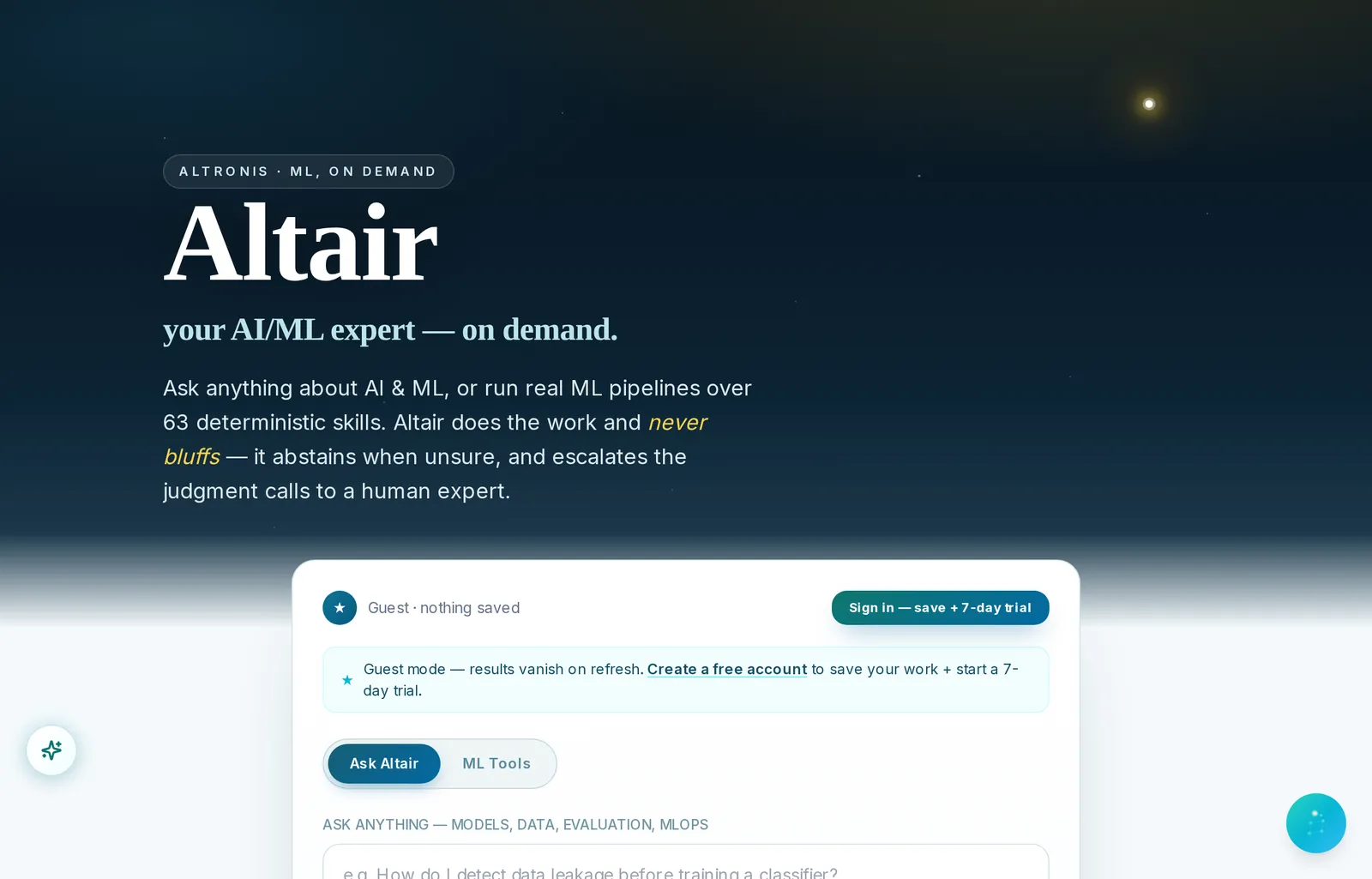
Altair: an AI/ML expert as a service - for Singapore teams that can't justify a full ML hire
Here is the gap I keep running into with Singapore SMEs. They have a real machine-learning need - clean up a messy dataset, build a churn or defect classifier, check whether a model is drifting, decide if a vendor's "AI" actually works - but the need is intermittent. It does not justify hiring a full-time ML engineer at SGD 8,000–15,000 a month, and a specialist consultant at SGD 200–450 an hour is hard to scope for a one-off. So the work just… does not happen. Or it gets handed to whoever on the team is least afraid of Python, and the result is a model nobody trusts.
So we built Altair. It is an AI/ML expert you use on demand. Ask it any ML question, or hand it an ML task and let it do the work - and a human signs off before anything load-bearing ships. It is live today, free to try.
What Altair actually does
Two surfaces, one engine.
Ask Altair. An open question box for anything ML - "How do I detect data leakage before training?", "Is F1 the right metric for an imbalanced fraud set?", "What does this drift report mean?". Plain answers, taught with everyday analogies, no jargon wall.
ML tools. One-click pipelines that run real analysis on your data, not a paragraph describing it: data-quality audit, end-to-end classification, regression, feature engineering, model selection and tuning, drift monitoring, statistical comparison. Under the hood are 63 deterministic ML skills - actual code that profiles, tests, trains and evaluates - so the output is auditable and reproducible, the same way a competent engineer's notebook would be.
Three things that make it not a chatbot
It never bluffs. Every load-bearing claim is gated on an uncertainty check. When Altair is not confident, it says so and abstains, instead of fabricating a plausible-sounding answer. "I don't know" is a first-class output. If you have ever been burned by an LLM confidently inventing an API that does not exist, this is the design choice that fixes it.
A human is accountable. Low-stakes work runs autonomously. Anything high-stakes or uncertain - touching production, deleting data, a result that looks off - escalates to a human at Altronis who reviews and signs off. You get AI speed with a person on the hook for the outcome. That is the part you cannot get from a raw model, and it is the part that matters when the work touches money or customers.
Real ML that runs. The tools execute deterministic pipelines on your dataset and return numbers you can check - distributions, leakage verdicts, baseline scores, drift indices. Not a confident-sounding summary of analysis it never did.
How you use it - guest, trial, then paid
Open Altair and you can start as a guest immediately - run the ML tools, ask questions, no signup. Guests save nothing; results live in the session. Sign in (Google or email) and you get cloud-saved history plus a 7-day full trial. After that, the Q&A sits behind a small subscription; the free tools stay open. The point of the free tier is honest: let you prove it works on your own questions before any money changes hands.
The honest limits
Altair is not a senior ML lead for novel research. It is very good at the bread-and-butter - the audits, the baselines, the evaluations, the "is this dataset even usable?" work that eats most of a real ML project - and it is honest about the rest. For genuinely hard, bespoke modelling, the right shape is Altair doing the grunt work and the drafting while a human makes the calls. Which is exactly how it is built: the agent is the labour, Altronis is the judge. And v1 is single-turn - it does one well-scoped task at a time, not yet a long autonomous multi-step engagement. That is the next step.
Why this shape, and not "hire an offshore data scientist"
Most Singapore SMEs weighing ML work are actually choosing between a one-off consultant, an offshore contractor, or doing nothing. Altair changes the math: the routine 70% of the work runs instantly and cheaply, you only pay a human for the judgment, and one accountable party (us) stands behind the result. It is the same principle we run the rest of Altronis on - AI does the labour, a human owns the outcome - turned into something you can click on.
Try it on something small and real: drop in a question you actually have, or run the data-quality audit demo. You will learn more in five minutes of using it than in any pitch. Altair is here.