By Z. Aw | Published | Updated
Nano Banana: Singapore search interest is surging in May 2026 - the practitioner read
Two of the top rising related queries on the Singapore Google Trends data for "AI image generation" this week are "Nano Banana AI" and "Nano Banana", both flagged as breakout. Under the "Gemini" seed the related-query "Nano Banana Gemini" is showing 63,000% growth. A few weeks ago none of those phrases registered in Singapore search at all. Now they are getting typed often enough to appear in the trends data with the kind of growth-rate Google only assigns when something has gone from near-zero to an actual question people are asking.
"Nano Banana" was the codename used internally and later semi-publicly for the image generation model Gemini ships. The codename was floating around the LMSYS arena leaderboards and some early-access Reddit threads for months before the public rebrand caught up. Somewhere in late April and early May 2026, mainstream Singapore awareness crossed a threshold - probably driven by a viral creator wave (image-restyling, retro-anime, the now-familiar "make me look like a 90s magazine cover" prompt cycles) - and the codename name stuck even after Google had moved on to calling the same system "Gemini image" or "Gemini 3 image generation" in their docs.
I run image generation as part of my own daily work - both locally on a Strix Halo box for in-house pipelines and on hosted APIs when I need the very-latest model quality. I have used Nano Banana / Gemini image extensively for client work, on top of Midjourney, ChatGPT's GPT image generation, Flux on local hardware, and a rotating cast of others. This post is the practitioner read on what the Singapore search wave is actually about and what to do with it if you run a small team that needs visual output.
What Nano Banana actually is, the unhyped version
Nano Banana is Google's name for the image-generation capability inside Gemini 3. You reach it through three surfaces today: the Gemini consumer app on web and mobile, the Gemini API (now under the broader Google generative AI platform), and the Imagen-branded product line for enterprise users via Vertex AI.
The consumer-app version is the one most people in Singapore are interacting with this month. You type a prompt into the Gemini chat, it generates four images, you can iterate by chatting "make it warmer", "add a singapore skyline", "change the woman's outfit to a cheongsam", and the model edits in place rather than starting over. That conversational-edit shape is the thing that broke into mainstream awareness. Older image-gen tools had it (ChatGPT image gen has had inpaint-by-prompt for over a year) but Gemini's version landed at a quality level where the edits feel reliable rather than frustrating, and that is what shifted the perception.
Under the hood it is a diffusion transformer the way most modern image models are. The technical interesting parts are: native multi-modal training (the model speaks text, image, and edit instructions in the same context), strong text rendering (you can ask for legible text inside an image and it usually delivers, where most competitors still fail at this), and the conversational editing loop is shipped as a first-class feature rather than a layered-on tool call.
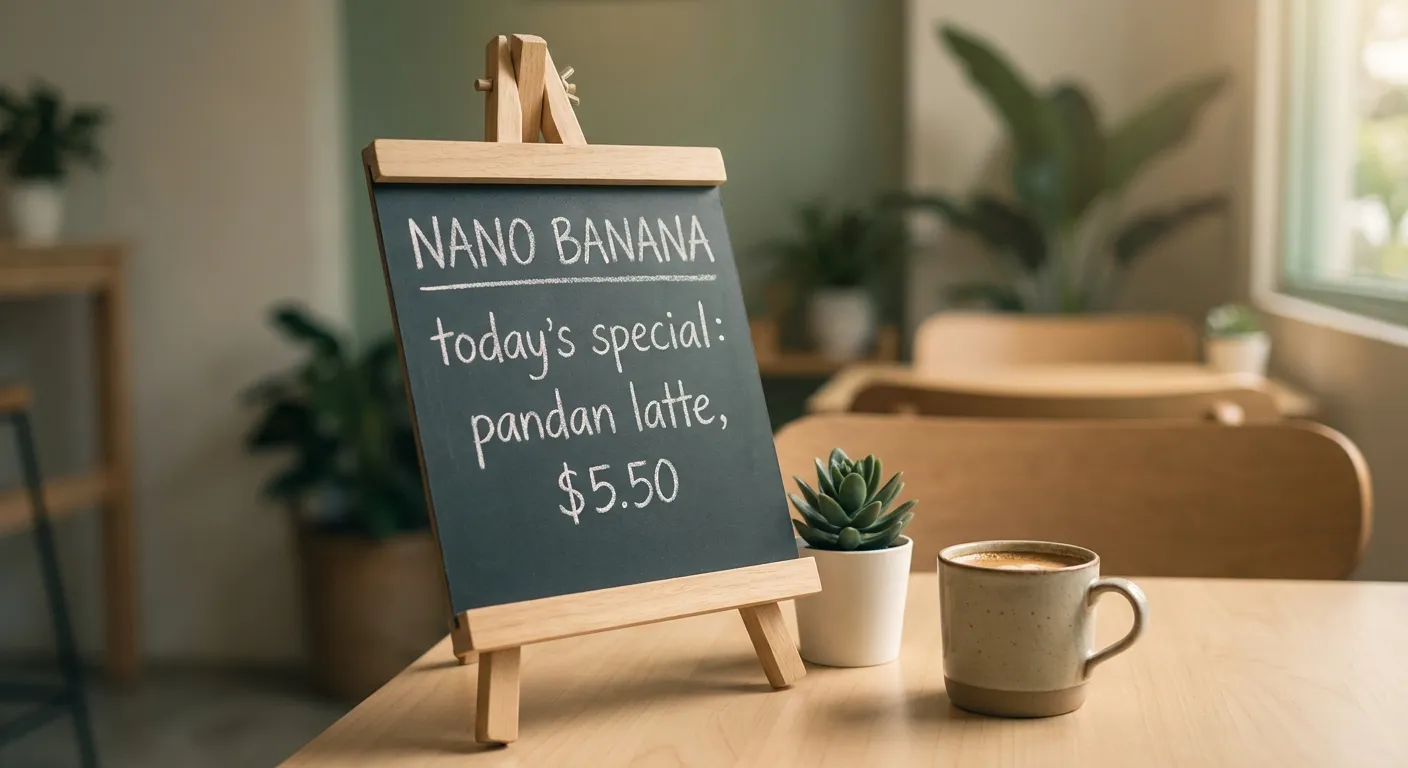
What the output actually looks like - samples generated for this post
Three fresh samples below, all generated for this post directly through the Gemini API on the nano-banana-pro-preview model (the current top-of-the-line of the Nano Banana family - Google ships Nano Banana under several model IDs depending on the surface, "pro preview" is the most capable of them as of this writing). Prompt → image → no editing. Each figcaption shows what the model was actually asked for so you can read the gap between intent and output on each one.
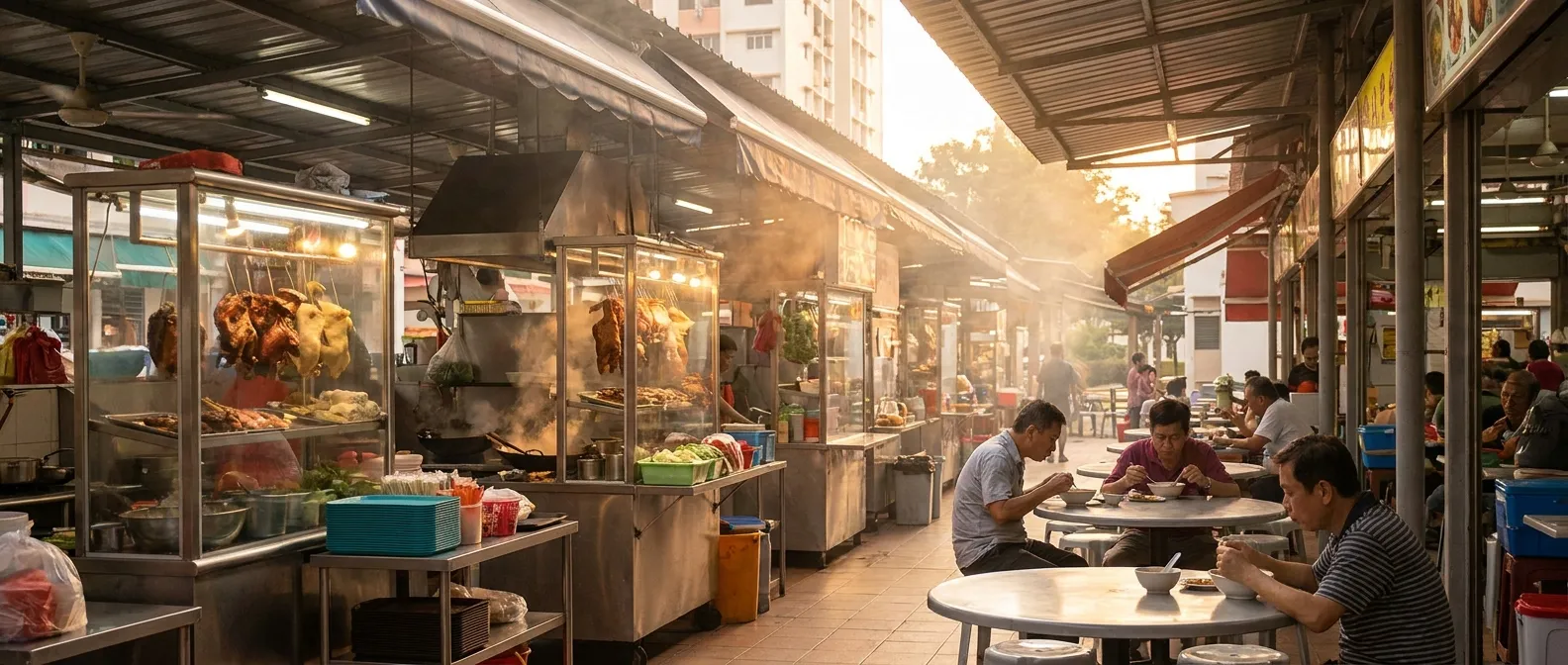


The practitioner read on the samples: Nano Banana Pro landed each in five to nine seconds end-to-end through the API, returned base64 inline, no queue wait, no model spin-up. The photoreal hawker scene is genuinely strong - natural light, plausible depth, no uncanny stock-photo feel. The isometric render is unusually high-fidelity for this kind of brief; six prompted elements all landed first try is rare in the field. The flat editorial illustration is on-brief and prompt-faithful, with one extra character thrown in, which is the kind of small drift you would clean up on a follow-up edit. Across all three the model held the prompt's explicit "no text" requirement, which most of the rest of the field still gets wrong.
The conversational-edit loop is the other half of why this model matters. As a quick demonstration, here is the same isometric desk scene above, prompted instead with "render with much warmer late-afternoon golden light streaming in from the right":

The choice between Nano Banana Pro and a local Flux pipeline is a cost / latency / privacy decision more than a pure quality decision for most SG SME briefs.
How it compares against the rest of the field
This is the comparison most SG readers are actually looking for, and the answer is messier than the marketing copy on any single product page admits.
Vs Midjourney v7. Midjourney still wins on raw aesthetic ceiling for stylised work - magazine-cover shots, painterly hero images, the editorial work that asks for a strong "look". If you give the same prompt to both, Midjourney's first generation will more often have the mood you wanted and Nano Banana's will be more literal but less moody. Midjourney loses on iteration speed, on the unfriendly Discord-then-web-app workflow, and on text inside images. For a SG marketing team that wants social-media hero images with brand text overlaid, Nano Banana is the easier tool. For an editorial designer crafting a one-of-a-kind cover, Midjourney still has the edge.
Vs ChatGPT image generation (GPT image, the model formerly known as DALL-E 4). These two are the closest competitors today. ChatGPT's image gen has the conversational-edit loop and very similar text-rendering quality. Nano Banana wins on photorealism for Asian faces in my testing - the ChatGPT model has a noticeable "Instagram filter" cast on real-looking people that Gemini avoids. ChatGPT image gen wins on prompt adherence for complex multi-subject compositions. For SG marketers shooting product photography mock-ups featuring real-looking local talent, Nano Banana is the slightly better default; for ads with three or four characters interacting in a specific scene, ChatGPT image gen handles the spatial reasoning better.
Vs Flux.1 dev / Flux.1 pro. Flux is the open-weights image model from Black Forest Labs. It runs locally on hardware you already own, it has zero per-image cost after the hardware investment, and the latest checkpoints are within striking distance of the closed-model leaders for most non-photorealistic work. Flux loses on text inside images, on conversational edits (you bolt that on yourself with ComfyUI workflows; it is not built in), and on the extreme realism end. Flux wins on cost (zero), privacy (your prompts and generated images never leave your machine), and on the customisability when you write your own ComfyUI graphs. For SG SMEs with sensitivity around brand assets - fashion brands generating product imagery, agencies generating client work where the prompts contain confidential brief detail - Flux on local hardware is the only honest answer.
Vs Stable Diffusion XL / SDXL-derivatives, Recraft, Ideogram. These all have niche strengths. Ideogram is the strongest at typography and logo-shaped output. Recraft is the strongest at vector and UI mockup work. SDXL is no longer the latest open model and has been mostly displaced by Flux for serious local work. For most SG SME use cases, none of these is the right starting point - but if your work is tightly typographic (lots of legible text), Ideogram is the single-purpose tool worth knowing about.
What Nano Banana actually costs in Singapore dollars
Three pricing surfaces, all worth keeping straight.
Gemini consumer app, free tier. The free tier of the Gemini app gives you a meaningful amount of image generation per day, and for most marketing-team needs (a few images a week) the free tier is enough. You get fewer iterations per session and lower-priority queue placement, but the model is the same.
Gemini advanced subscription. USD 20 a month - SGD 27 inclusive of card fees - for unlimited (in practice, very-high-quota) image generation, faster queue placement, and access to the longer-context conversational-edit features. For a small marketing team where one or two people are doing image work daily, this is the rational choice.
Vertex AI / Gemini API. Google charges per image at the API level, in the order of USD 0.04 - 0.08 per generated image depending on resolution and model variant. For an automated marketing pipeline that generates hundreds of images a week (e-commerce product shots, ad-creative variants), this is where you live. For any work that requires regulatory-grade audit trails or runs through a programmatic pipeline, the API is the only legitimate path.
Practical things SG SMEs can actually do with it this week
I want to be specific here because the trend wave is going to push a lot of "AI is going to revolutionise marketing" content and most of it is useless. Here is the boring, working list.
Social-media hero images for blog posts and LinkedIn updates. If you are an SG SME founder publishing on LinkedIn (which you should be), you can use Nano Banana to generate a custom hero image per post in under two minutes. The alternative is Unsplash stock photos that look generic, or expensive freelance illustrators. The cost is one Gemini advanced subscription. The quality bar is high enough now that the output reads as "intentional editorial choice" rather than "AI slop". The discipline you need is to write a prompt that does not include text-on-image, because text-on-image still goes wrong about 20% of the time and that is the failure mode that makes a post look amateur.
Product mock-ups for e-commerce listings. For SG SMEs selling physical products on Shopee, Lazada, Qoo10, you can photograph your product on a plain background and ask Nano Banana to extend the scene - put it on a kitchen counter, on a beach, in a hotel room - to generate lifestyle shots without a photo shoot. This works very well for products where the product itself is the focus and the surroundings are atmosphere. It works less well for products where the lifestyle context is the selling proposition (fashion on a model is the canonical hard case; you need a real model shoot for that, not an AI version).
Presentation imagery and pitch-deck visuals. For any deck where you have been pasting in stock photography to fill out concept slides, replace the workflow. You can generate one custom image per slide that reflects your specific business in fifteen minutes total. This is one of the highest-leverage uses for any marketing-adjacent role in a SG SME; the uplift in pitch-deck production value is large and the cost is zero on top of an existing subscription.
Internal documentation and process diagrams. I did not see this coming until a client asked. Nano Banana is surprisingly good at generating clean process diagrams, organisation charts, and architectural-style technical diagrams from natural-language prompts. If your SOP documents are wall-of-text and you have always wanted them more visual, this is a fast path. Flag for honesty: AI-generated diagrams require a careful human pass for accuracy. They look right; they are not always right. Treat them as draft layouts, not final source of truth.
Localisation of stock imagery. For SG SME web pages featuring "diverse team" images that have always been generic Asian-American stock photos, you can ask Nano Banana to generate the same scene with a specifically Singapore composition - multi-racial, HDB-style background, local food in the frame. This is a small thing but it noticeably changes how a website reads to local visitors. The discipline is to be conservative with the prompt; pushing too hard on "make this look very singaporean" trips into stereotyped output that is worse than the generic version.
Where it goes wrong, and where it surprised me on the upside

Three things I have hit in the last six weeks where the failure mode is real.
One. Brand-asset consistency across a campaign is hard. You generate a hero image you love. You ask the model to generate three more variants with the same person, same outfit, same lighting. You get three completely different people. Nano Banana has gotten better at this with reference-image input, but it is not solved. For any campaign that needs visual consistency across a series, plan for either a real photo shoot with the model providing background variants, or a longer iteration cycle than you would expect.
Two. Text inside images still fails 20% of the time. The model can render legible text most of the time, but on long captions, on stylised fonts, on multi-line layouts, you will still get gibberish or near-gibberish. The workaround is to generate the image without text and overlay the text in Canva, Figma, or Photoshop. That is annoying but it removes the failure mode entirely.
Three. Copyright and brand-likeness handling is still fuzzy. The consumer app refuses to generate likenesses of recognisable public figures (good) and refuses to generate copyrighted character likenesses (also good). It will sometimes accept prompts that get close to a brand's distinctive style without copying it directly, which is a grey-area workflow. For any SG SME using the output commercially, the safe rule is to not prompt against any specific brand or figure, ever. Write generic prompts and accept generic-but-distinctive output.
The trend curve in three to six months
The Singapore search-trend wave on Nano Banana is going to keep climbing for another four to eight weeks, then plateau, then transition into the slower steady-state baseline that all mainstream-aware tools settle into. The "what is" queries die off; the "how do i" queries grow; the "vs Midjourney" queries are starting to surface this week and will dominate by July.
The more interesting curve to watch is what happens with the API side. Consumer awareness is the noisy front of a wave; API integration into ad-tech, marketplace photo pipelines, e-commerce backends is the durable behind. By year-end every Shopee or Lazada seller using software-assisted product photography will be running through one of Nano Banana, ChatGPT image, or a Flux-based pipeline as their primary production tool. That infrastructure shift is the thing that actually changes the SG SME economics, not the consumer-app virality.
If you are a SG SME owner reading this and the only thing you take away is one action, it is - open gemini.google.com today, paste your most-used product or service into a prompt, and generate four hero images. That fifteen-minute exercise will tell you more about whether the trend matters for you than any number of explainer articles. The rest is detail.